

Generative engine optimisation explained: how AI answers find sources, what makes a useful citation and where to start.
A prospective customer asks ChatGPT, Gemini, Perplexity or Google’s AI search which option fits their business. Your company might appear in the answer, a competitor might receive the recommendation, or your article might be cited for a detail that has little to do with what you sell. Those outcomes look similar in a visibility dashboard. Commercially, they can be very different.
Generative engine optimisation (GEO) is the practice of improving your content, technical access and public information so relevant AI-generated answers can find, accurately represent and cite your business. It combines familiar SEO foundations with a closer look at the sources, claims and recommendations inside an answer. The useful goal is a credible introduction to the right customer, followed by somewhere worthwhile to go.
Being mentioned is not the same as being cited. Being cited is not the same as being the right answer. Check the claim your page supports, not just whether your logo or URL appeared.
How does generative engine optimisation work?
GEO improves the path between a useful source and an AI-generated answer. For a web-grounded response, a system can retrieve relevant material, select information and produce an answer with supporting links. Your work is to make the right information accessible, specific and worth using.
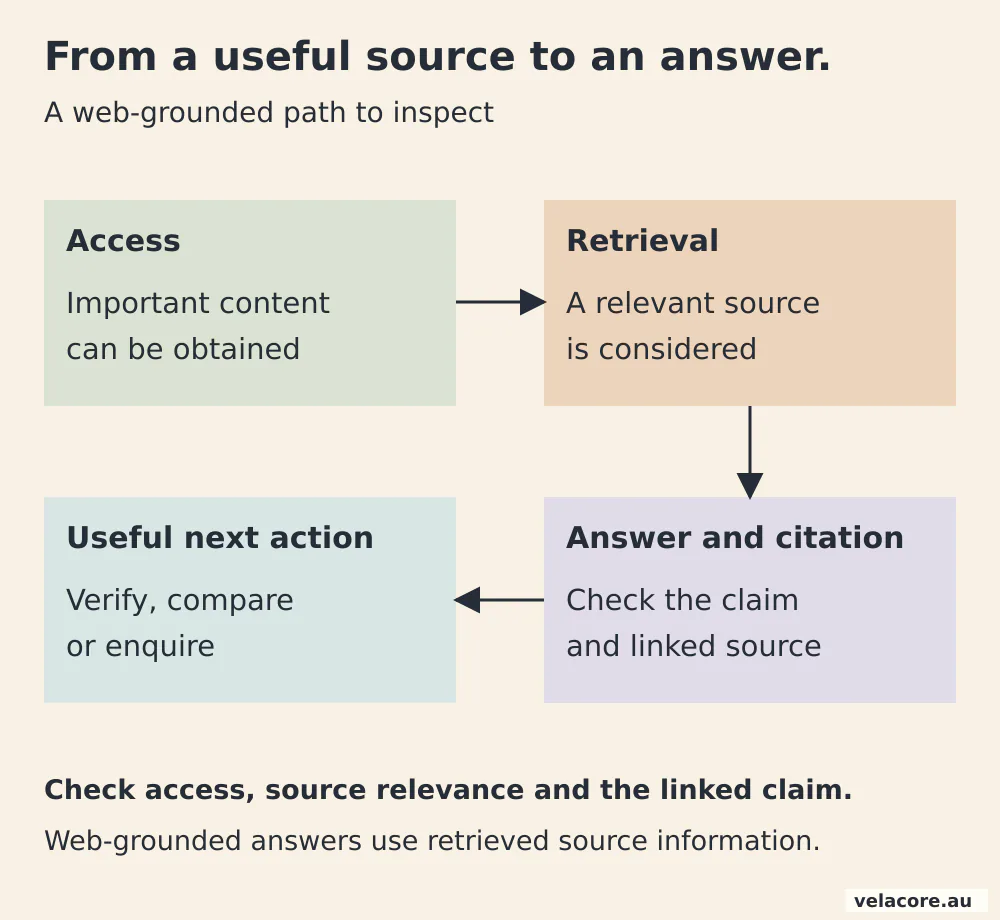
Retrieval means finding material to help answer the question; grounding means using sources to support the response. These are different from an assistant answering from its existing model knowledge. Not every response involves a fresh visit to your website, and not every brand mention contains a citation.
A large language model (LLM) generates language. An answer product can combine that model with search, retrieval tools and a source-link interface. Optimising the published source is different from changing the underlying model.
Consider five parts of the journey:
- Access: the relevant system can obtain the important page content.
- Retrieval: the page is a useful candidate for the actual question and its related needs.
- Selection: specific information helps construct the answer.
- Attribution: a visible link identifies a supporting source.
- Next action: the reader can verify the detail, compare options or contact the business.
Those are review questions, not a published scoring formula. An access problem needs technical investigation. A weak explanation needs better information. An inaccurate recommendation needs you to inspect the source and correct the underlying facts where possible. Adding the same FAQ block to every page does not address all three.
Google’s generative-AI search guide describes grounding and related-query retrieval while maintaining that SEO foundations still apply. Treat that as Google’s account of its systems, rather than assuming every assistant has an identical process.
GEO vs SEO: what changes and what stays useful?
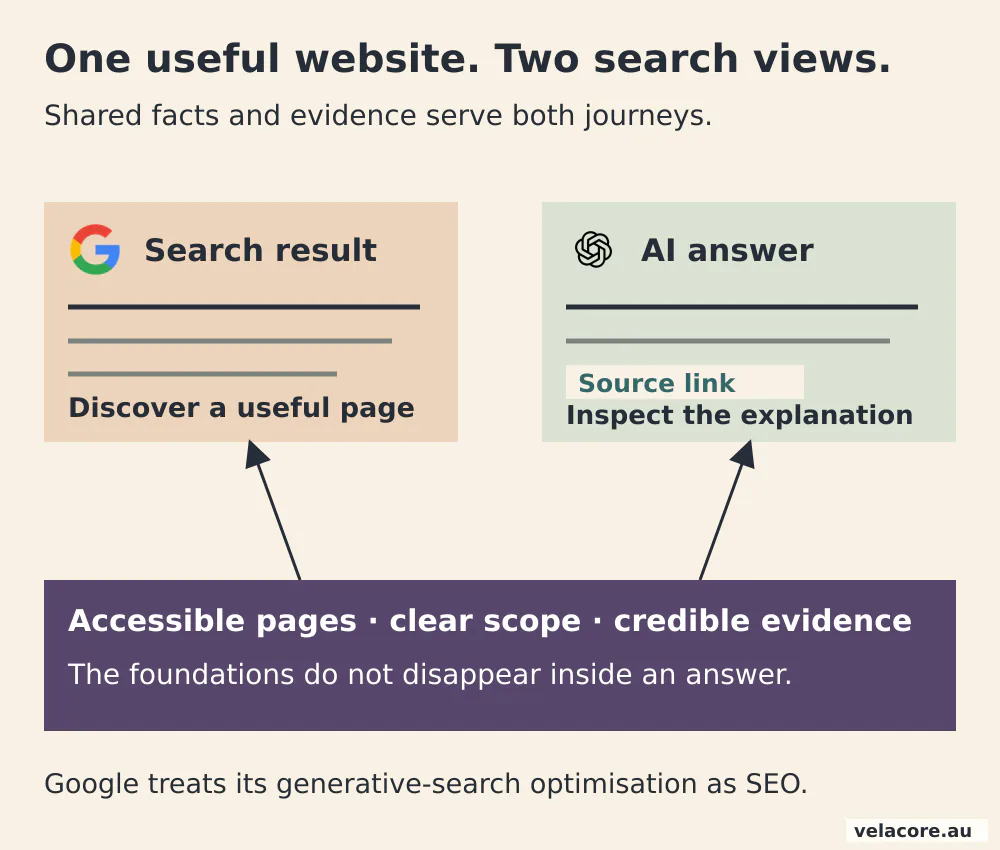
GEO puts more attention on how a business is represented inside generated answers. It does not make crawlability, useful pages, ordinary search visibility or a working website obsolete. For Google, optimising generative search remains part of SEO.
| Term | Typical emphasis | Useful question to ask |
|---|---|---|
| SEO | Search discovery, useful indexed pages and relevant visits across search features | Can suitable customers find and use the right page? |
| GEO | Source selection, accurate representation and citations in generated answers | What does the answer say about us, and which source supports it? |
| AEO | Answer-engine optimisation, often covering direct answers and overlapping AI-search work | Does the content resolve the actual question clearly? |
| LLMO | A label for work concerning large-language-model discovery and representation | Which product, retrieval behaviour and outcome are being discussed? |
A strong service page can support a conventional search result and an AI answer. Its clear scope, current facts, evidence and internal links remain useful in both settings. The extra work is checking whether generated answers select the relevant page and describe the offer correctly.
For example, a business can rank for a broad category while a specialist source is cited for a narrow technical question. That does not prove rankings are worthless. It tells you that the answer needs information beyond the page ranking for the original phrase. Our AI Overview citation guide explores that selection problem in more detail.
What does the research tell us about GEO?
Research shows that source presentation and AI-referred visits can matter, but the method and population determine what a result means. Read the finding before turning it into a business forecast.
- The term has a research foundation: the GEO research paper, first released in 2023 and accepted at KDD 2024, introduced a 10,000-query benchmark and reported visibility improvements of up to 40% in its experiments.
- AI referrals are growing in measured markets: Adobe’s August 2026 report found AI-referred visits to US retail sites rose 62% year over year in July.
- Visitor quality needs its own measurement: Adobe also reported a 60% higher conversion rate for those AI referrals than non-AI traffic in that retail dataset.
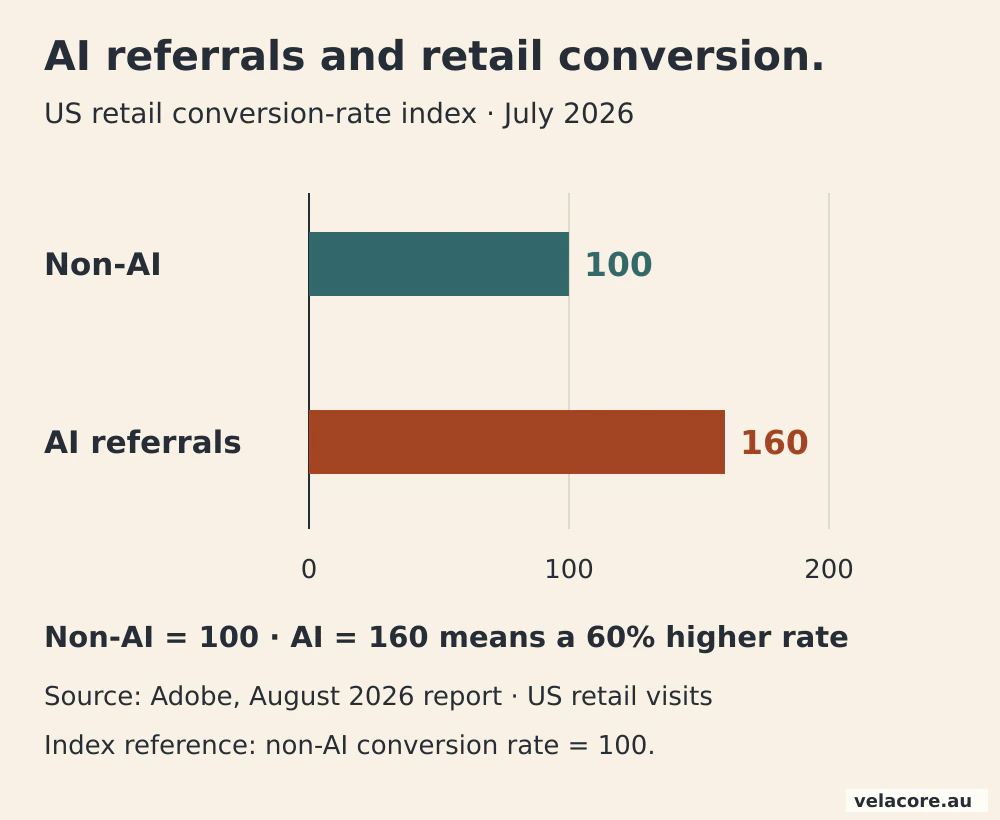
The paper’s maximum is not an average improvement you can promise a client, and its visibility measure is not website revenue. Adobe’s result describes referred visits in US retail, not a universal conversion rate for ChatGPT, Claude or your service business. In an indexed comparison, non-AI conversion is 100 and AI conversion is 160; those are relative values, not 100% and 160% purchase rates.
The practical lesson is to improve source usefulness and inspect the visits you actually receive. Neither study establishes that adding a citation, statistic or particular paragraph length causes a fixed commercial uplift.
A small referral channel can still bring valuable visitors. In its June 2025 own-site analysis, Ahrefs reported AI search generated 0.5% of visits but 12.1% of signups, with conversion 23 times higher than traditional organic traffic. That combination makes volume and conversion worth reviewing together, rather than dismissing a channel because it sends fewer sessions.
Make your page useful for the claim an answer needs
A useful GEO source supports the specific claim being made. The page should help a reader understand what is true, why it is true and what decision follows from it. A brand mention attached to the wrong question is a poor substitute.

Imagine a business offering content-localisation work. A buyer asks, “Can this team help us use AI to localise content without publishing unapproved claims?” A generic page about the benefits of AI gives the answer engine little evidence about the actual service.
A better page explains the workflow: where approved source content lives, which fields can be translated or adapted, who reviews market-specific claims, how publishing approval works and how corrections reach each language version. Add genuine scope, relevant examples and source documentation where needed.
| Buyer question | Evidence the page should supply | Useful next action |
|---|---|---|
| Can publication require approval? | The actual roles, review gates and publishing responsibility | Map the required approval process |
| What affects the project scope? | Content volume, markets, integrations and review requirements | Prepare a comparable scope brief |
| How are errors corrected? | The change, propagation and recovery process | Check who owns a correction |
| Is this suitable for our team? | Specific prerequisites, boundaries and verified experience | Discuss the actual delivery fit |
This is where expertise becomes visible. Explain the constraint people miss, show a worked calculation, compare options using the same criteria or provide a practical worksheet. A reader should finish knowing something they could not get from a generic definition.
The best source is useful before an AI system touches it. Clear writing makes that usefulness easier to see; it cannot replace evidence that does not exist.
Check AI access without confusing search with training
Search access, user-requested page visits and model training are different purposes. Check the actual product and crawler before changing your rules. A setting for one purpose does not automatically control the others.
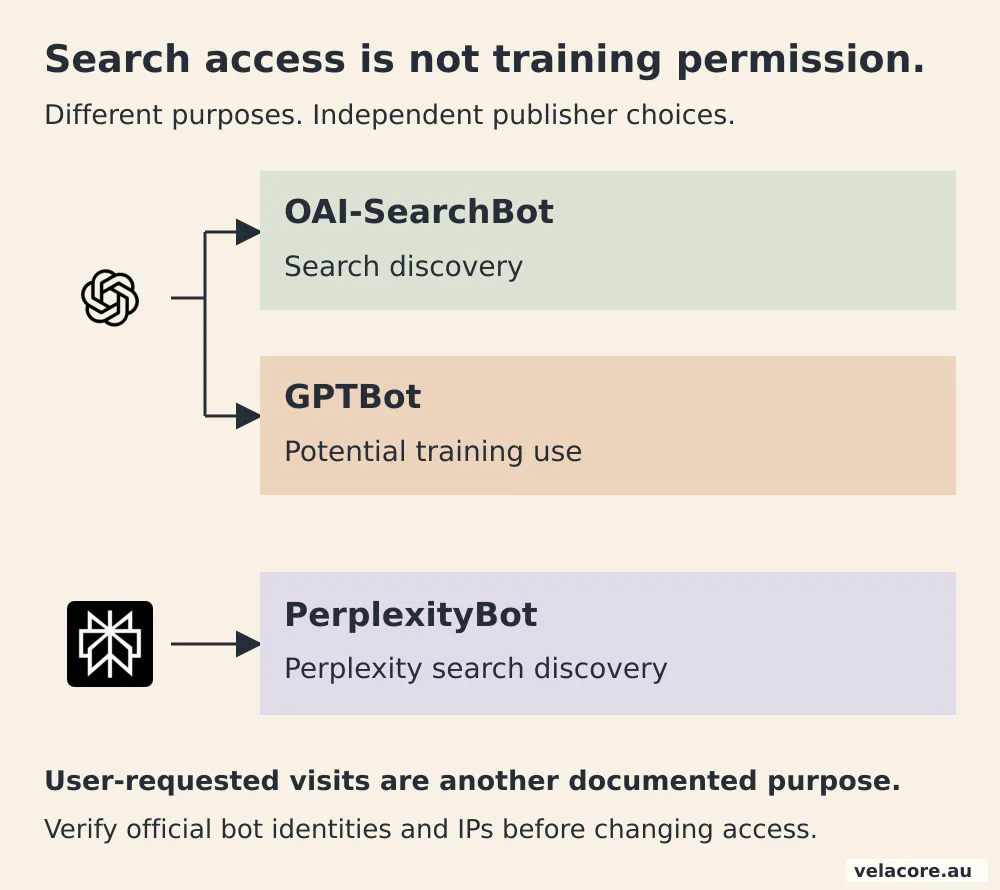
OpenAI’s crawler documentation distinguishes OAI-SearchBot for search from GPTBot for potential training use. It also documents ChatGPT-User for certain user-initiated visits. A publisher can make separate search and training choices; allowing training is not the admission price for appearing in ChatGPT search.
Perplexity’s crawler guidance similarly distinguishes its search crawler from user-initiated retrieval. If your firewall blocks a request, verify the published bot identity and official IP information rather than trusting a user-agent string or switching protection off.
For Google, check indexing and snippet eligibility, then the effective Search generative AI setting in Search Console. It may inherit a parent property’s choice. That control is distinct from ordinary Search exclusion and from model-training controls.
Ask a developer to inspect what a relevant request actually receives: a normal page, a challenge, an error or a shell with little meaningful content. A working page in your signed-in browser does not prove every crawler receives the same thing. Equally, the presence of JavaScript does not prove a page is invisible. Test the delivery problem instead of diagnosing it from the technology name.
Use structure and entity clarity to explain real facts
Readers and systems need to distinguish your company, services, people, products and places. Use consistent names and specific relationships, then keep the important explanation readable on the page.
A company profile should match its genuine identity and coverage. An author biography should describe real expertise. A comparison should identify the actual products and versions involved. A statistic should link to its original source, with the population and period that make it meaningful.
Structured data can describe those visible facts and connect the page, organisation and author. It should not add claims that the content cannot support. For Google, there is no special GEO schema or required llms.txt file; the official guidance explicitly separates those conventions from Search eligibility. Other systems may use machine-readable exports for their own purposes, but that is a different claim.
Use clear headings and answer the reader’s question early because it helps the reader. Keep tables, lists and definitions where they clarify the task. Do not force every section into an arbitrary word count or strip useful detail to make the page resemble a snippet.
Review an AI citation for accuracy, not just presence
An answer can cite your page and still misrepresent what it supports. Follow the actual link, identify the claim beside it and compare that claim with the visible source. This is the step a simple mention count misses.

Return to the localisation example. Suppose an answer says the team provides fully automatic publishing, while the source explains that a human approval gate is required. The link is real, but the description is wrong. Counting that as an uncomplicated visibility win hides the problem.
Check three things:
- Relevance: does the cited page answer the buyer’s actual question?
- Support: does the source substantiate the claim made beside the link?
- Consequence: would a reader arriving with that expectation understand the real offer?
Correct unclear or outdated source content where that is the cause. If the page is already accurate, record the response and use the platform’s available feedback route where appropriate. Do not rewrite a truthful service promise to match a mistaken generated answer.
Choose a real customer question, save the dated response and open one citation. Write down the claim it is supposed to support, the relevant source passage and the next correction or improvement. That is a concrete GEO task, even when the answer does not need another page.
Measure AI search visibility separately from business results
Measure exposure, accurate citation, visits and suitable outcomes as related observations with different meanings. Keep the platform, question, market, date and sampling method visible so a change can be interpreted.
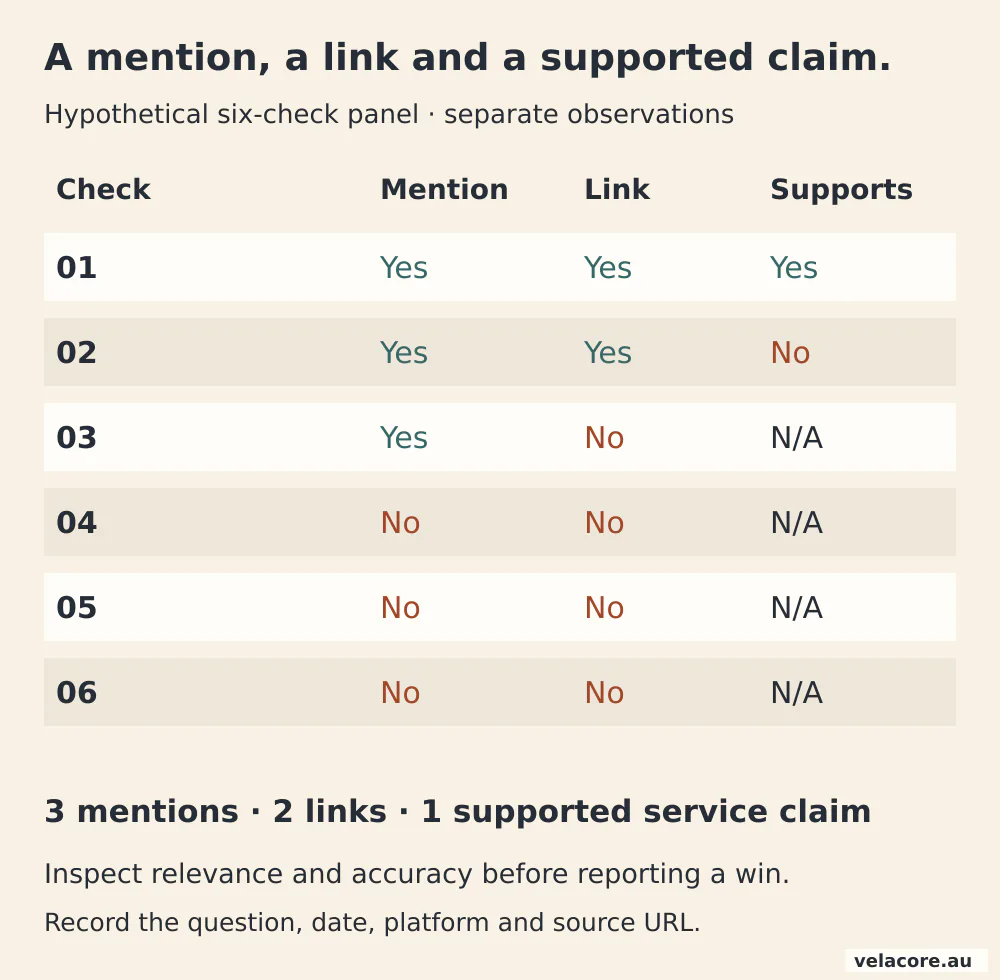
Start with a repeatable set of genuine buyer questions. For each check, record whether the business is mentioned, whether a relevant URL is linked and whether the linked source supports the claim. Also record cases where no relevant generated answer or citation appears. Do not compare percentages after silently changing the question set or denominator.
For example, six hypothetical checks might produce three brand mentions, two linked citations and one citation that supports the relevant service claim. Those counts reveal different issues. They are not three measurements of the same success rate, and they are not a share of the whole market.
Google’s Generative AI performance report shows impressions for AI Overviews and AI Mode, with page, country, date and device views. It may not appear until the property has enough impressions. It is not a complete question-by-question citation history or a standalone conversion report.
For visits from assistants, inspect referral and landing-page data alongside accepted enquiries or purchases. A rise in direct traffic does not prove an assistant caused it. Our AI assistant traffic in GA4 guide explains the attribution work; the AI visibility tools guide helps interpret monitoring scores.
For a concrete comparison, Seer’s single-client study, covering October 2024 to April 2025, recorded a 15.9% conversion rate from ChatGPT referrals versus 1.76% from Google organic. Compare each assistant’s visits and completed outcomes in your own reporting, so a small stream of well-qualified visitors remains visible alongside the larger search channel.
Use the visibility measure to find the next question. Use business outcomes to judge the value of the work.
A five-step GEO starting plan
Begin with a narrow set of worthwhile questions and a source page your team can improve. Give the work an owner and a clear review method before expanding it across the website.
- Choose the decision: select customer questions connected to a genuine service, product or comparison.
- Check access: confirm the important content and appropriate inclusion choices for the platforms you are targeting.
- Improve the source: add accurate scope, distinctive evidence and a useful next action.
- Review the answer: inspect the citation, supported claim and buyer expectation, not just a mention count.
- Measure and refine: repeat the same observations and review relevant website outcomes before choosing the next change.
Avoid the familiar detours: paying for mention volume without relevance, publishing near-duplicate pages, manufacturing credentials or adding unsupported statistics to look quotable. These can make a page noisier while making its evidence less dependable.
For the detailed content task, continue with the GEO content-optimisation guide. This page explains the discipline and the decisions behind it; the implementation guide takes the editing work further.
Frequently asked questions
Does generative engine optimisation replace SEO?
No. Technical access, useful content, credible information and relevant visits remain important. GEO adds attention to source selection and representation inside generated answers. Google explicitly describes its generative-search optimisation as SEO rather than a separate set of admission tricks.
Is GEO the same as AEO or LLM optimisation?
The labels overlap. GEO usually emphasises generated answers and citations; AEO often refers more broadly to answering questions; LLM optimisation can cover how language-model products discover or represent information. Ask which platform, page, task and outcome a proposal actually covers.
Does my website need llms.txt or special schema for GEO?
Google does not require special AI files or schema for its generative Search features. Use accurate structured data where it describes real content and maintain exports only for systems that use them. A file or markup block cannot substitute for an accessible, useful source.
Must I allow AI training to appear in ChatGPT search?
No. OpenAI documents independent choices for search access through OAI-SearchBot and potential training use through GPTBot. User-initiated retrieval is another purpose. Review the official controls and your publishing policy instead of assuming every AI request needs the same permission.
How quickly can GEO produce results?
There is no universal citation deadline. Timing depends on discovery, retrieval, the questions checked, competition and the changes made. Agree delivery and review milestones, then judge the actual observations and website outcomes. A promised citation by a fixed date is not a dependable planning basis.
Is GEO worthwhile for a smaller business?
It can be, when suitable customers research questions your business can answer credibly. Start with an important offer and useful source page, not an enterprise-sized monitoring programme. Keep the investment proportional to relevant discovery, accurate representation and suitable enquiries.
Give the answer a source worth using
Generative engine optimisation starts with information that deserves to be found and represented accurately. Make the offer clear, make its evidence traceable and check the claim attached to the citation. Then measure whether the next visitor finds something useful.
Explore Velacore’s SEO and AI search approach or contact the team about your search visibility priorities if you need help connecting that work.