
A practical new-build budget guide: what you pay for, what keeps costing money and how to compare the work behind the quote.
You need a new website, but the quotes are not speaking the same language. One sells a monthly subscription. Another offers a small package. A third starts with discovery and a custom design. They may all show attractive pages, yet cover very different work.
Website cost in Australia depends on the type of build, its content and the functionality behind it. Velacore’s website cost calculator starts with base allowances of A$3,500 to A$6,500 for a brochure or portfolio site and A$6,500 to A$12,000 for a small-business site. Page volume, content support and functionality are then added to that base.
A subscription buys access to software. A website project buys the work that makes it useful to your business.
This guide is for commissioning a new website. If you are keeping or replacing an existing site, use our separate website redesign cost guide, which covers retained content, rebuild decisions and SEO migration.
- Shopify Basic lists A$42 per month on annual billing and A$56 on monthly billing. Those are platform charges, before the work of building your store.
- auDA’s 2026 research reports that 80% of Australian consumers are more likely to trust an Australian business with a .au website. Domain choice and control belong in the plan.
- WebAIM’s February 2026 study detected WCAG failures on 95.9% of one million home pages. Accessibility needs an actual checking allowance, not a promise attached to a design mockup.
1. Match website development cost to the job
Choose the kind of website your business needs before deciding how much to spend. A concise service site, an online store and an operational platform have different delivery responsibilities.
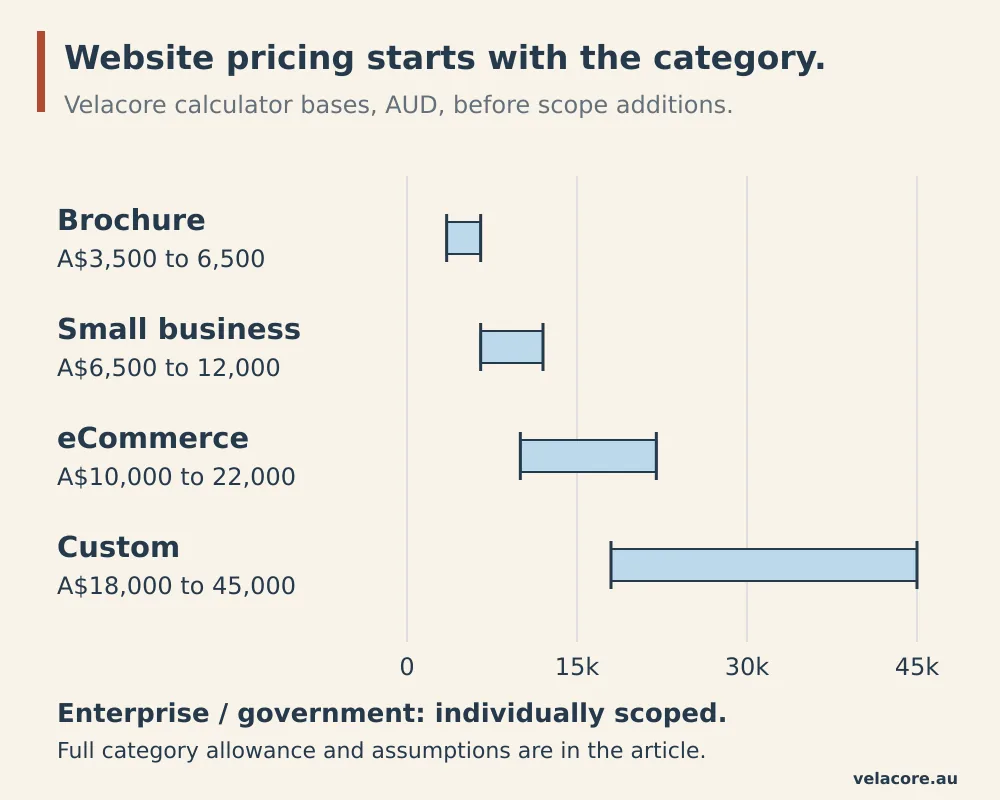
The figures below reproduce Velacore’s current calculator base allowances in Australian dollars. They are the starting inputs to our estimate model, not national market averages or fixed packages. The page, content and functionality adjustments come next; the proposal confirms inclusions, GST and third-party costs.
| Project type | Calculator base, AUD | What makes it the right category |
|---|---|---|
| Brochure or portfolio | A$3,500 to A$6,500 | Clear presentation, a manageable content structure and standard enquiry needs |
| Small-business website | A$6,500 to A$12,000 | More developed service architecture, messaging and customer journeys |
| eCommerce | A$10,000 to A$22,000 | Product and category structure, checkout and operational selling requirements |
| Custom website | A$18,000 to A$45,000 | Bespoke user experiences, content models, logic or integrations |
| Enterprise or government | A$40,000 to A$120,000+ | Governed scope with more approvals, accessibility, security and integration requirements |
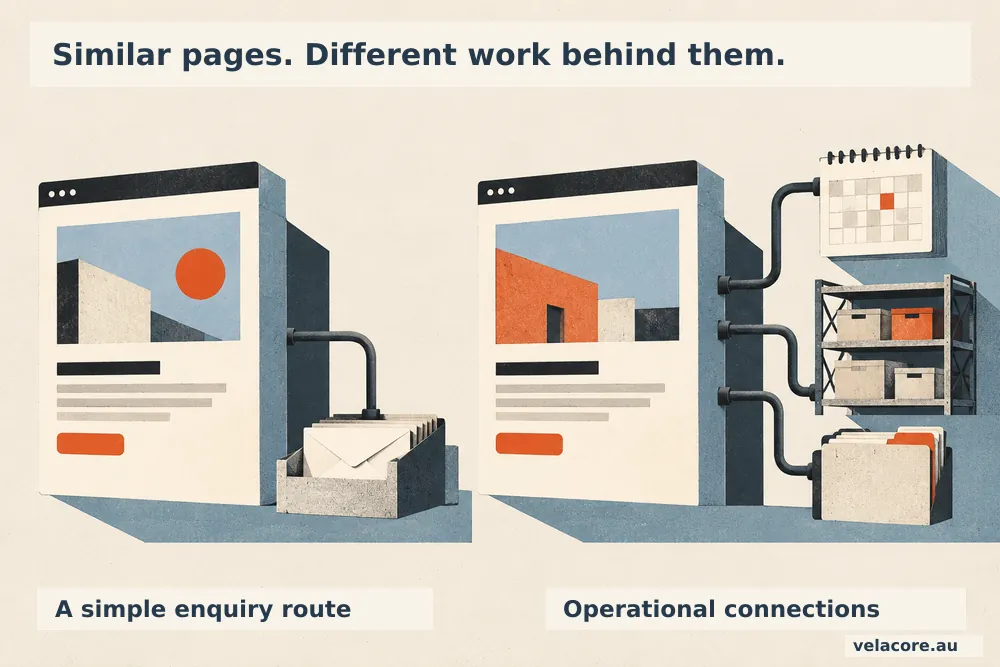
A small organisation does not automatically need the “small business” category. A lean brochure build may be enough. Equally, three pages with a booking workflow and customer portal are not a basic brochure site just because the menu is short.
Write down the job in plain language: explain three services, receive suitable enquiries, sell a defined catalogue, or support a specific customer task. That sentence does more for the budget than collecting screenshots of sites you like.
2. Calculate website cost in Australia from the actual scope
Build the estimate from the selected category plus its page, content and functionality requirements. Keep those assumptions visible so the result can be explained and reproduced.
For example, select Brochure / Portfolio, 4 to 8 pages, We already have the content and Standard website functionality in the Velacore calculator. The result is A$4,500 to A$9,000.
| Selected input | Lower allowance | Upper allowance |
|---|---|---|
| Brochure / Portfolio base | A$3,500 | A$6,500 |
| 4 to 8 pages | +A$1,000 | +A$2,500 |
| Content already prepared | +A$0 | +A$0 |
| Standard functionality | +A$0 | +A$0 |
| Configured estimate | A$4,500 | A$9,000 |
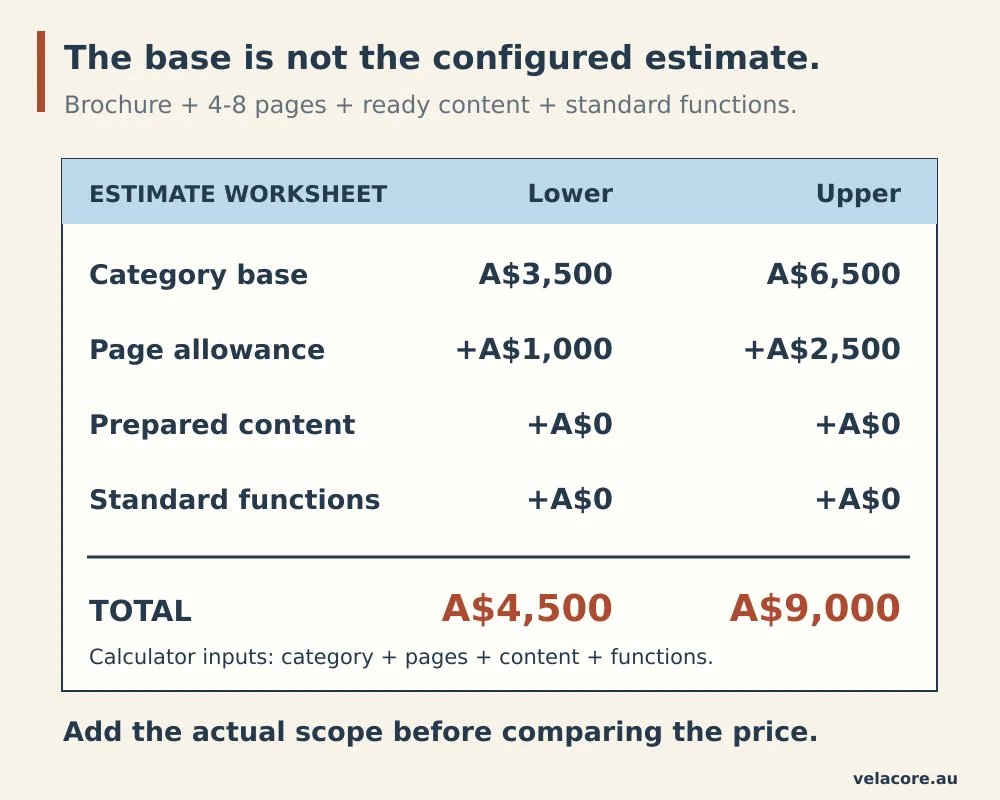
The model adds each lower and upper allowance, then rounds the totals outward to A$500 boundaries. These particular totals already land on those boundaries. It does not mean every site with six pages has the same price.
Next, separate pages from templates. Six service pages using one well-designed layout require different work from six entirely different page experiences. New copy, original images, searchable records and approval flows also change what must be created and checked.
Before requesting a proposal, prepare:
- A page list: the essential pages and what each helps a visitor do.
- A content decision: who supplies approved copy, product information, photography and brand assets.
- A functional list: standard enquiries, appointments, payments, accounts or integrations.
- An operating owner: who will edit, support and maintain the website after launch.
Use the calculator to find the right conversation, then use discovery to turn those assumptions into an agreed scope. It is a better starting point than asking three suppliers to price three different websites.
3. Choose the delivery model without confusing it with quality
DIY, a freelancer and an agency are different ways to organise delivery. None guarantees a good result, and a template does not automatically make a website poor.
A DIY builder can suit a small, straightforward site when you have the time and judgement to handle the content and customer journey. A specialist freelancer can be a strong fit for a focused scope. A multidisciplinary team becomes useful when strategy, writing, design, development and integrations need coordinated ownership.
| Route | Useful when | Check before committing |
|---|---|---|
| DIY builder | The site is straightforward and you can own content and setup | Your time, plan limits, mobile usability, account control and ongoing tasks |
| Freelancer or specialist | You need a defined skill set and direct delivery contact | Capacity, relevant work, scope boundaries, support and handover |
| Agency or delivery team | Several disciplines or stakeholders must work together | Who actually does the work, decisions, approvals and responsibility after launch |
Platform choice is a separate decision. WordPress is open-source software; hosting, design, content, maintenance and commercial extensions still require resources. Squarespace packages website tooling and hosting into a managed service. Shopify centres its platform on commerce. Your build fee pays for the actual configuration, design and business-specific work around the chosen platform.
A custom or headless build should solve a real need, such as structured content across channels or an unusual workflow. It also creates front-end, integration and operational responsibilities. “Custom” is a scope decision, not a badge that automatically improves search performance.
Our Squarespace, WordPress and custom website comparison explores that choice. Velacore delivers website and platform projects, so our recommendation here is grounded in the work we scope: choose the smallest dependable arrangement that does the job and can be maintained.
4. Add the costs that continue after launch
Separate the one-off build fee from the services needed to operate the site. A first-year budget should show both, including when an introductory allowance ends.
Security and recovery belong in that operating budget. ASD’s 2022-23 Cyber Threat Report put the average cost per reported cybercrime for small businesses at A$46,000. Ask who applies updates, monitors faults, tests recovery and takes responsibility when something goes wrong; those are ongoing delivery tasks worth pricing explicitly.
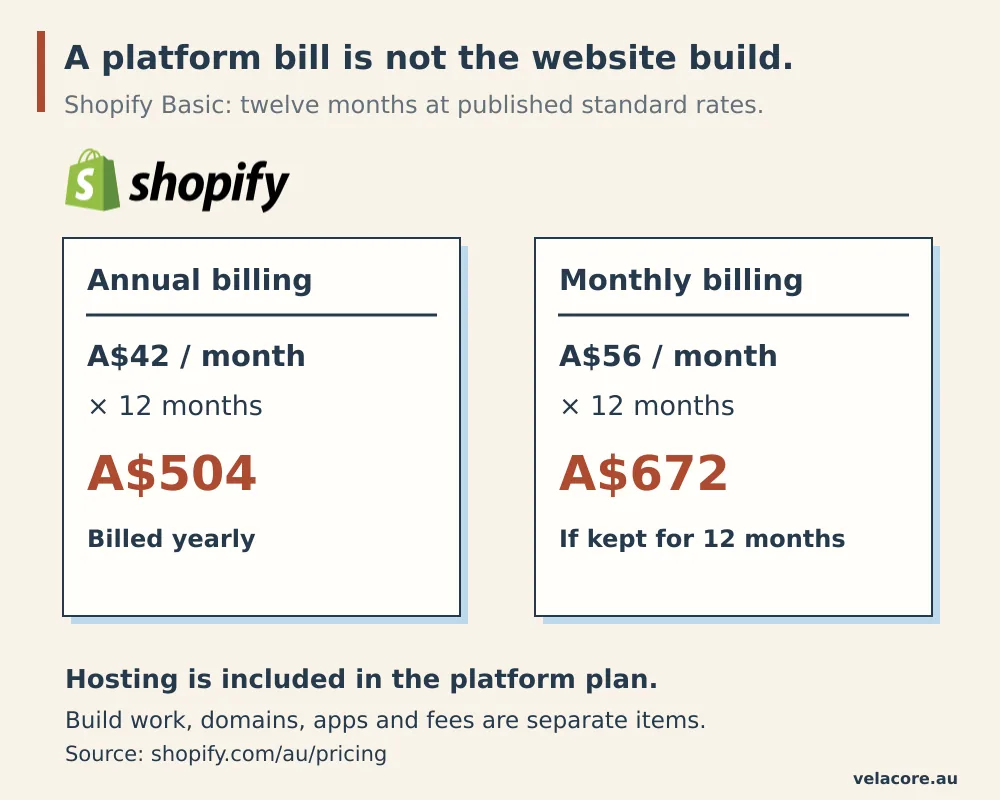
As a concrete example, Shopify’s Australian pricing lists Basic at A$42 per month when billed yearly, or A$56 on monthly billing. That is A$504 versus A$672 over twelve months at those published standard rates. The billing commitment differs; neither figure pays for your entire store project.
Shopify includes hosting in its platform plan, while apps, premium themes, domains and transaction-related charges can add costs. Do not add a second generic hosting allowance to a hosted platform without explaining what it covers. For self-hosted software, identify hosting and maintenance responsibilities separately.
- Domain and business email: registration, renewal, account ownership and mailbox costs.
- Hosting or platform: the normal renewal rate, billing period and required plan.
- Extensions and external services: licences, booking tools, search, forms, stock assets or APIs.
- Support and upkeep: updates, recovery arrangements, monitoring, edits and response expectations.
- Growth activity: future content, SEO, advertising and optimisation beyond the launch scope.
Domain control is worth getting right from the start. In its April 2026 report, based on February market research, auDA reports that 80% of Australian consumers are more likely to trust an Australian business whose website ends in .au. That supports a domain decision; it does not prove that a domain will generate a particular sales increase.
Compare quotes on the same GST basis and ask which third-party charges are included. A$6,000 including GST and A$6,000 excluding GST are not the same commercial offer. Your proposal should settle that explicitly rather than leaving you to interpret the calculator as a tax invoice.
5. Buy a working customer journey, not just page designs
A new website should launch with its essential tasks working: a visitor understands the offer, navigates it, makes an enquiry or purchase, and receives the expected confirmation.
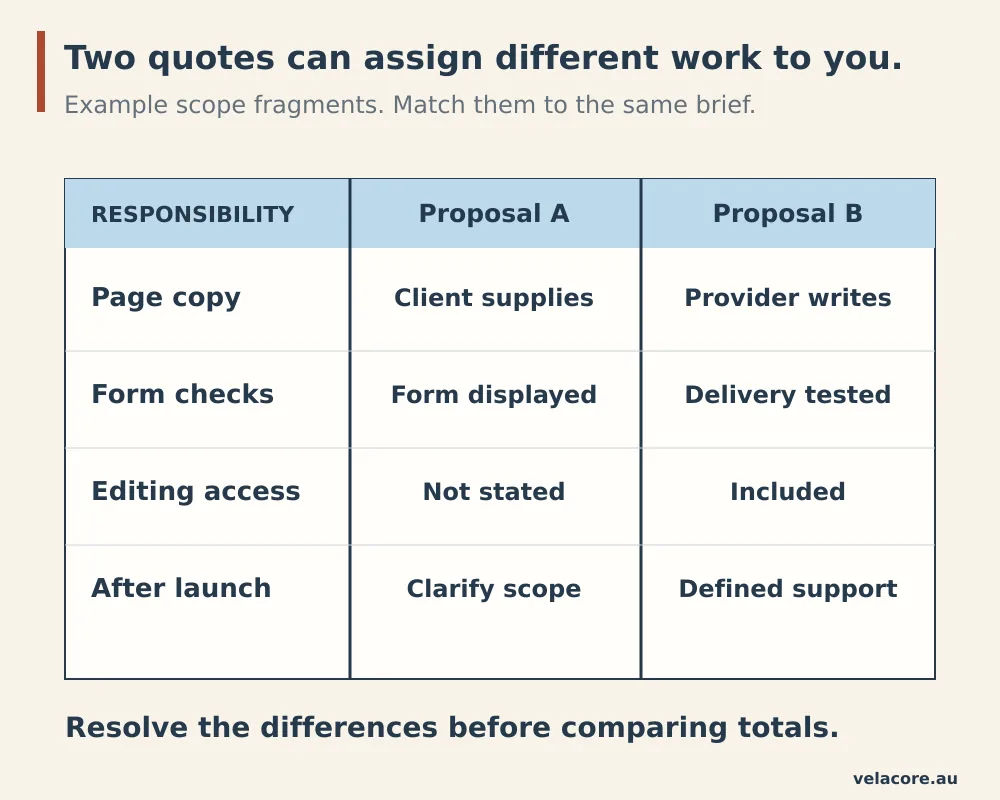
Ask the proposal to name the deliverables and how they will be checked. That includes the agreed content work, responsive layouts, forms, editing setup, search foundations and handover. The exact responsibilities matter more than labels such as “premium”, “SEO-ready” or “fully optimised”.
Performance deserves a named deliverable too. Aberdeen’s November 2008 research, based on more than 160 organisations, reported a 7% average conversion impact from an additional second of response-time delay. Budget for appropriately sized images, efficient implementation and a tested enquiry or checkout journey, rather than treating speed as an optional polish item after launch.
Google’s SEO guidance covers making pages discoverable and understandable. For a new build, request a clear structure, crawlable content, descriptive page metadata, internal links, canonical URLs and an appropriate sitemap. Launch SEO foundations and an ongoing search campaign are different services.
The same applies to accessibility. WebAIM’s 2026 automated analysis found detectable WCAG failures on 95.9% of one million home pages; it also explains that automated tests cannot detect every issue. Use WCAG 2.2 to agree the relevant requirements and evidence, with keyboard, form, contrast and mobile checks alongside automated testing.
“A visitor can submit a valid enquiry on mobile, correct an error without losing their work, and receive confirmation. The team receives the message and knows who responds.” That is more useful than a line saying “contact form included”.
If an existing domain, indexed page or business system is involved, identify the dependency before launch. Keep working URLs where appropriate; redirects are for genuine moves. A new visual design is not a reason to discard useful search history.
6. Test the commercial case with sales and margin
Estimate what a new website could support using your actual sales process. A visitor is not an enquiry, an enquiry is not a customer, and sales revenue is not the amount available to recover the build cost.
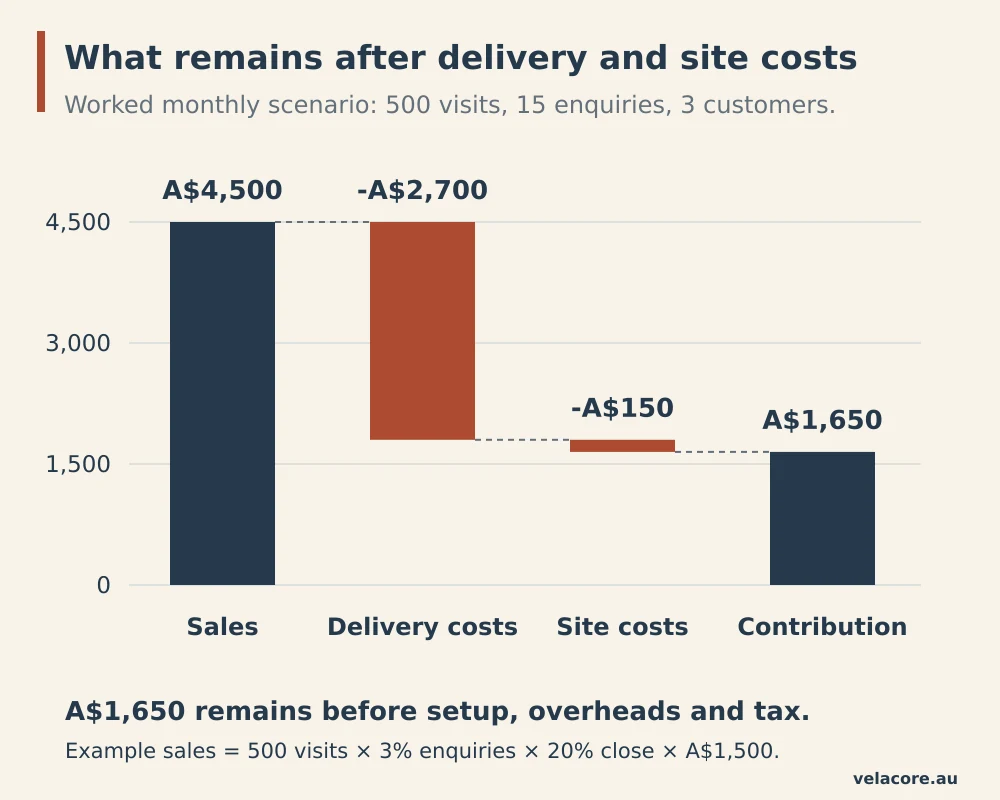
Here is a hypothetical monthly planning scenario. The figures are selected to show the arithmetic, not presented as Australian industry benchmarks or a promised result. A new site has no demonstrated website baseline, so replace these inputs with observed data after launch.
| Input or calculation | Monthly example |
|---|---|
| Website visits | 500 |
| Accepted enquiry rate | 3%, producing 15 enquiries |
| Enquiry-to-customer rate | 20%, producing 3 customers |
| Average sale | A$1,500 |
| Sales revenue | 3 × A$1,500 = A$4,500 |
| Direct delivery costs | 60% of revenue = A$2,700 |
| Contribution after delivery | A$1,800 |
| Website operating costs | A$150 |
| Available toward setup and other overheads | A$1,650 |
The 40% contribution assumption means direct delivery consumes the other 60%. The A$1,650 remainder is before other overheads, tax and recovering the website’s setup cost. It is not net profit, and it is not proof that the website created all three sales.
Check how the model changes if traffic arrives slowly, fewer enquiries qualify or delivery costs are higher. Existing referrals, repeat customers and paid campaigns also matter when assessing where sales came from. Avoid turning a comparison with another website’s conversion rate into a claim that your business is losing that amount every month.
Budget against the contribution a sale leaves behind, not the headline value of a lead.
For the measurement behind that decision, see our small-business marketing funnel guide. It connects website activity to qualification, follow-up and customer outcomes.
7. Compare the scope, ownership and launch plan together
Compare proposals against the same brief, then agree who owns each decision and deliverable. A smaller price can be a good offer, a narrower scope or missing work; the number alone does not tell you which.
Do not assign a quality premium purely to Sydney, Melbourne, Perth or another city. Compare the actual team, relevant work, communication, scope and support. Location may matter for workshops or time zones, but it is not a reliable standalone pricing formula.
Ask for these commitments in writing:
- Scope: page and template assumptions, functional requirements, supplied content and exclusions.
- Commercial terms: milestone payments, GST, third-party costs, change pricing and renewal charges.
- Delivery: stages, approval dates, client responsibilities and how delayed inputs affect launch.
- Acceptance: the agreed customer tasks, accessibility/performance checks and defect handling.
- Ownership and exit: domain/account control, editing access, licences, source or export arrangements and training.

A realistic schedule includes discovery, content, design, development, review and launch. Work can overlap, but an unapproved offer or unavailable product information will still delay the result. Agree dependencies and milestones instead of assuming every new website fits the same number of weeks.
Common budget mistakes are buying a plan before defining the site, counting every page as identical work, comparing a launch-only quote with a managed service, and leaving content or account ownership until the final invoice. Resolve those decisions early and the price becomes much easier to judge.
Buy a clear scope, a working website and a handover your team can actually use. To plan your project, explore Velacore’s website and platform services, try the website cost calculator, or discuss the website you need to build.
Frequently asked questions about website cost in Australia
How much does a small-business website cost?
Velacore’s small-business category starts with a base allowance of A$6,500 to A$12,000 before page, content and functionality adjustments. A simpler brochure site may fit the A$3,500 to A$6,500 base instead. Use the calculator selections and a written scope to establish the full estimate.
Is the calculator result a fixed price?
No. It is a configured planning range built from the selected category and scope allowances. The formal proposal confirms the deliverables, exclusions, GST, third-party charges and final project price.
Does a monthly platform plan include building the website?
Usually the plan covers access to platform features and, for hosted builders, hosting. Design, content, product setup and integrations are separate work unless an offer explicitly includes them. Check the normal renewal rate as well as any introductory discount.
Is a lower-priced website automatically a bad choice?
No. A focused template-based build or DIY setup can suit a straightforward requirement. Check what is included, who maintains it and whether the essential customer tasks work. Price alone does not prove poor quality or a particular delivery location.
Who should control the domain and accounts?
Your business should retain appropriate control of its domain, primary accounts and recovery access. Agree delegated supplier access, editing rights, third-party licences and exit arrangements before work begins. A supplier can manage services without making your business dependent on an inaccessible account.
Should I budget for AI features or a headless CMS?
Budget for them when they solve a defined operational or publishing need. Include the associated integration, review, security and support work. A simple service website does not need an AI assistant or separate front end merely to be modern.
Will redesigning an existing website cost the same?
Not necessarily. A redesign may reuse content and reliable components, or add migration and legacy-cleanup work that a new site does not need. Use the redesign budget guide to assess that scope rather than treating the two projects as interchangeable.